
Permeable vs non-permeable driveways
SUDS compliance, UK planning rules, sub-base construction and long-term performance — the engineer's guide to choosing the right driveway system.
Permeable for most residential driveways. Non-permeable where load and use demand it.
A permeable driveway lets rainwater soak through the surface and an engineered open-graded sub-base into the ground below. A non-permeable driveway sheds surface water sideways to a drain, soakaway or permeable area. For most Cheshire front-garden drives, permeable resin bound on a Type 3 sub-base is the right specification — it's SUDS-compliant, usually avoids planning, and outperforms non-permeable construction on longevity because water is engineered through the structure rather than trapped in it.
Non-permeable construction — machine-laid tarmac, standard block paving, concrete — still has its place: long private drives, farm and estate roads, commercial hardstanding, and repairs to existing sound bases. The question isn't which is "better" — it's which is engineered for the site, the loading and the drainage brief.
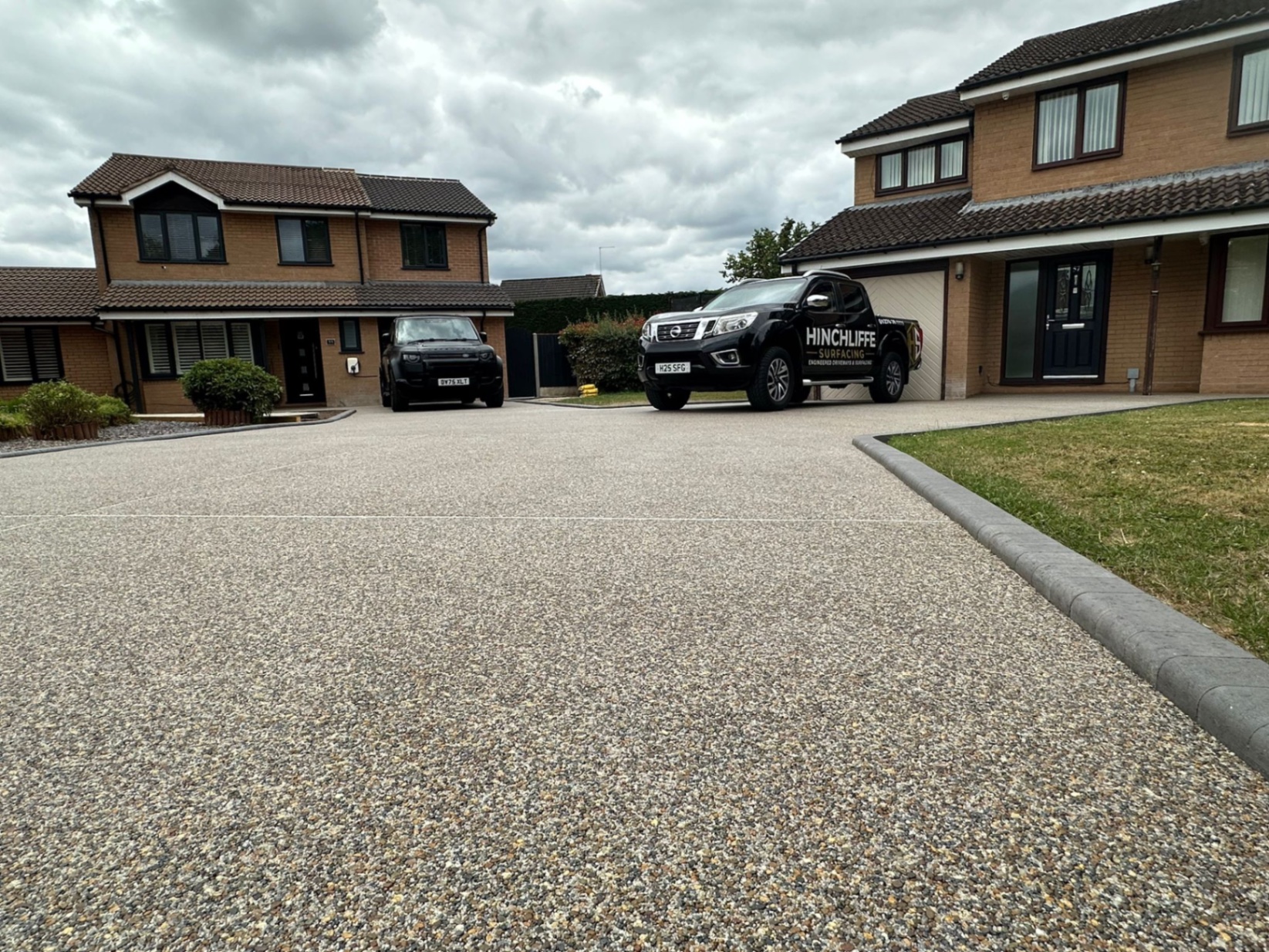
Permeable vs non-permeable — the technical differences
| Factor | Permeable | Non-permeable |
|---|---|---|
| Surface water | Infiltrates through the surface and open-graded sub-base into the ground below. | Runs off the surface — must be directed to a soakaway, drain or permeable area. |
| Sub-base construction | Open-graded Type 3 stone — engineered voids allow water to move through and be stored. | Closed-graded Type 1 MOT — dense, load-bearing but non-permeable. |
| Typical surfaces | Resin bound, permeable block paving (with jointing aggregate), open-jointed setts. | Tarmac, standard block paving with sand joints, concrete, resin bonded (loose scatter). |
| Planning permission (front garden > 5 m²) | Not usually required — meets government SUDS guidance for permitted development. | Required unless run-off is directed to a permeable area within the property. |
| SUDS compliance | Compliant by design. | Only compliant if run-off is captured and attenuated on site. |
| Freeze-thaw risk | Very low — water is not trapped in or under the surface. | Higher — trapped moisture expands on freeze, causing cracking and lifting. |
| Puddling & standing water | None on a correctly engineered build. | Possible if falls, drainage or edge levels aren't set correctly. |
| Best-fit applications | Front-garden driveways, courtyards, pathways, patios, SUDS-critical sites. | Access roads, farm and estate driveways, commercial hardstanding, heavy-vehicle areas. |
When permeable is the right specification
- Front garden driveway larger than 5 m² where you want to avoid a planning application
- Sites in Northwich, Sandbach and other Cheshire postcodes where SUDS compliance is expected
- Properties on clay or with a high water table where surface run-off is a known issue
- Areas where puddling, freeze-thaw damage or edge lifting have caused previous drives to fail
- Any resin bound driveway — permeable construction is the standard, not the upgrade
When non-permeable is the right specification
- Long private drives, farm tracks and estate roads carrying regular vehicle loading
- Commercial forecourts, delivery yards and industrial hardstanding designed for HGV loads
- Repair or overlay of an existing tarmac or concrete drive with a sound, well-draining base
- Sites where run-off can be directed to an existing soakaway or permeable landscaped area

Why permeable driveways usually avoid planning permission
Under UK permitted development rules, a new or replacement front-garden driveway larger than 5 m² does not require a planning application if the surface is permeable — or if run-off is directed to a permeable area within the property. A permeable resin bound driveway on an engineered open-graded Type 3 sub-base satisfies both tests by design.
Permeable driveways across Sandbach, Cheshire and the North West
We're based in Sandbach and specify engineered permeable driveways across Cheshire East, Cheshire West and South Manchester. Every town has its own ground conditions, drainage constraints and planning context — here's how permeable vs non-permeable typically plays out locally.
Our home town. Victorian and Edwardian frontages on heavy Cheshire clay — permeable resin bound on a Type 3 sub-base handles the poor infiltration and eliminates the puddling common on flat plots off Crewe Road and Middlewich Road.
Sloping plots around West Heath and Buglawton benefit from permeable construction — water is engineered through the sub-base rather than sheeting down driveways onto the pavement.
Newer estates around Manor Lane and London Road often have restricted highway drainage. A SUDS-compliant permeable drive removes the run-off objection entirely and usually avoids planning.
Large front gardens on Sandbach Road North and Crewe Road suit permeable resin bound — the surface stays clean and puddle-free across the seasons.
Properties near the Trent & Mersey often sit on made-ground and old salt workings — we CAT4 survey, then engineer a permeable build sized for the ground conditions.
Terraced and semi-detached streets around Nantwich Road and West Street have limited off-street drainage. Permeable resin is usually the cleanest route to a compliant, planning-friendly drive.
Period properties around Welsh Row and Hospital Street need a specification that respects the streetscape — permeable resin bound in a stone-blend colour reads as gravel but performs as engineered surfacing.
Sites near the Weaver and Dane are drainage-sensitive; permeable construction on a correctly sized Type 3 sub-base is often the only defensible specification.
Larger driveways off Toft Road and Manchester Road frequently combine a non-permeable machine-laid tarmac carriageway with a permeable resin bound frontage — best of both, engineered to the site.
Sloping plots on the Prestbury and Tytherington side need engineered edge restraint and drainage design — permeable construction manages surface water without relying on the highway gully.
Permeable vs non-permeable — common questions
We survey your ground conditions, drainage and loading, then recommend a permeable or non-permeable build engineered to your site — not to a habit.